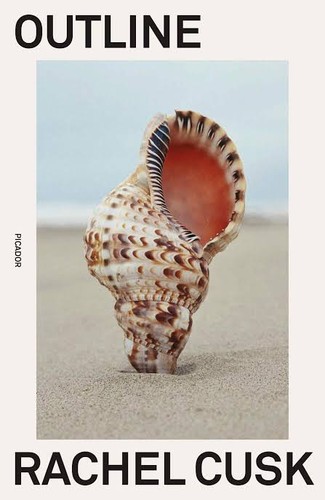
This one’s a strange fit for a site that mostly talks about spaceships and pack minds, and I almost didn’t review it, but I keep thinking about it months later so here we are. A writer named Faye flies to Athens to teach a summer course and the entire novel is just people talking to her, on the plane, at dinner, in her classroom, unloading their marriages and divorces and disappointments while she mostly listens. You don’t learn her name until near the very end, dropped in almost as an afterthought, and that choice is the whole argument of the book: you come to know a person by the shape of what’s missing from them, the outline rather than the fill.
There’s a moment on the plane where her seatmate’s eyebrows are described as growing “unexpectedly coarsely and wildly from his forehead, like grasses in a rocky place,” and I stopped and reread that line three times just to sit with it, because that’s Cusk’s whole method in miniature, one exact, slightly odd physical detail standing in for a person’s entire interior life. I’ve seen her compared to Sebald, and I get why, that same sense of a narrator positioned as a kind of camera rather than a participant, though I found Cusk warmer than that comparison suggests, or at least warmer than I expected going in.
Word of warning: almost nothing happens, plot-wise, for two hundred pages, and the parade of monologuing strangers can start to blur if you’re not paying close attention, several readers have flagged that the speaking voices don’t differentiate as much as they should. I found myself putting it down for days at a stretch and then reading fifty pages in one sitting once I found the rhythm again. Four stars rather than five because I wanted slightly more of Faye herself by the end, even knowing that withholding her is the entire point. Still, a book that gets stronger the longer you sit with it after finishing, which is rare enough that I’ll forgive the slow middle.